A One-Room Film Exercise: Build a Scene Around a Sound
A one-room film exercise built around a chosen sound helps you shape suspense, audience expectations and a clear scene using simple household props.
A one-room film exercise can make a sound carry the story before a character explains anything. Choose one ordinary noise, decide what viewers will expect from it, then build a short scene that changes the meaning of that expectation. You can plan the exercise with paper, a phone for playback and whatever objects are already in the room; recording expertise is not required.
What can a small sound make viewers expect?
Start with a noise that has a recognisable shape: three taps, a kettle click, a phone vibration, a key scraping against a door. The sound should be easy to imagine and repeat. A sprawling noise such as “traffic” may establish atmosphere, but it is harder to use as a precise clue in a short scene.
Now ask what a viewer might infer before seeing its source. Three taps could suggest someone asking to be let in. A phone vibration might signal an urgent message. The sound becomes dramatically useful when the audience forms one reasonable expectation and the scene later confirms, complicates or redirects it.
Keep the sound’s story job modest. It might prompt a character to hide something, interrupt a decision or reveal that a person is listening. The noise need not solve a mystery on its own; it only needs to change what the audience watches for.
How does the invented scene take shape?
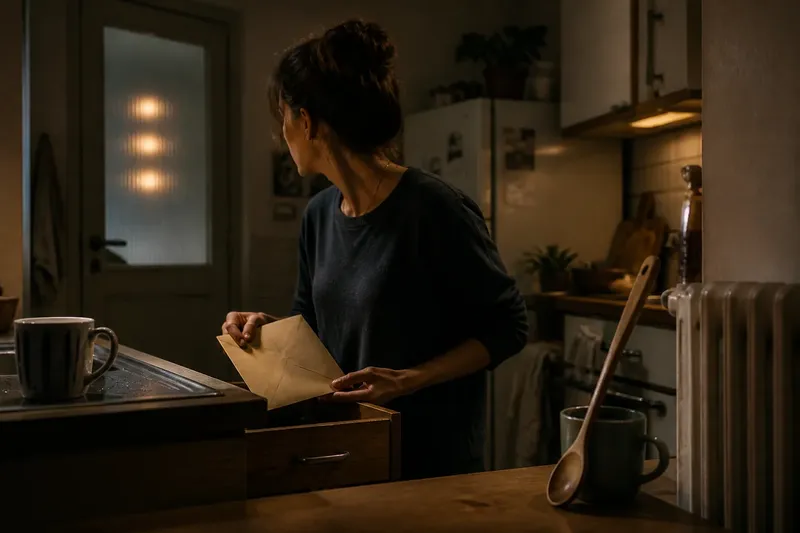
Imagine a hypothetical short film set in a small kitchen. Mara is alone, holding a sealed envelope above a rubbish bin. From the hallway comes a familiar pattern: three light taps. She slips the envelope into a drawer and turns towards the door, expecting her flatmate.
For the first appearance, the taps arrive while Mara is doing something ordinary, such as rinsing a mug. That gives the audience room to hear the pattern and notice her reaction. She does not need to announce, “That must be Eli.” A glance at the door and the quick movement of the envelope tell us what she believes.
The taps return. This time Mara does not approach the door. She waits, listening. A third set comes from the other side of the room, near the radiator. The source is a loose wooden spoon that she left balanced against a mug; a small vibration has set it knocking. The scene’s turn is not simply that the noise was harmless. Mara now realises how readily she treated an expected visitor as an audience for the envelope she wanted to hide.
For the result, give her a visible choice. She can take the envelope from the drawer and place it on the table before anyone arrives. The sound has prompted the action, while its real source has changed the scene from an imagined confrontation into a private decision. This ending uses the noise to alter behaviour rather than explain the plot.
How can you plan the sound without recording it?
Make a simple sound score on a sheet of paper. Draw a line down the page for the scene’s progress and mark each appearance of the chosen noise. Beside each mark, write what the audience knows, what the character assumes and what changes afterwards. This keeps the sound tied to dramatic movement rather than decoration.
- First appearance: establish the pattern and show the character’s immediate reaction.
- Second appearance: repeat the pattern, but let the character make a different choice.
- Revelation: show a plausible source that fits the room and changes the audience’s interpretation.
- Final beat: let the character act on what the sound has prompted, not merely look surprised.
For a low-equipment planning pass, write the noise as a cue such as “three light knocks, with a pause between each”. You can tap the rhythm on a table or say “tap” while reading the scene aloud. A phone’s voice memo app can help you remember an idea, but there is no need to capture a polished effect or decide how it will be mixed.
Make the sound distinct from ordinary room activity. If the kitchen already contains a running extractor fan, a quiet tapping pattern could be difficult to imagine over it. In the script, you might have Mara switch the fan off before the second occurrence. That small action gives the audience a reason to focus and gives the character an active response.
What should stay visible in a one-room scene?
The audience needs enough clues to follow the changing interpretation, but not a guided tour of every object. In the kitchen scene, a mug, spoon, drawer and door are enough. Place the imagined source where it can plausibly make the noise, then let the character’s attention lead the viewer towards it.
Sound perspective can be suggested in writing without technical notation. A muffled knock from beyond the door feels different from a dry tap beside the mug. Words such as “distant”, “close” or “dull” can describe the intended impression. The point is to give collaborators a playable idea, not prescribe equipment or specialist recording methods.
Keep the one-room limit useful. A sound from outside the room can enlarge the world without requiring another location. A sound whose source is in the room can make familiar objects feel newly suspicious. Choose whichever arrangement gives the character a meaningful response, and avoid adding extra noises that compete with the central cue.
Which questions help shape the exercise?
How many times should the sound recur?
Use it often enough for the audience to recognise a pattern, but make each return change the scene. If the noise repeats without altering what the character or viewer thinks, it is probably not earning its place.
Does the sound need to be realistic?
It should be plausible within the scene, though it need not reproduce a real recording. A written cue can suggest rhythm, distance and texture so the audience understands the intended event.
What if viewers guess the source early?
That can still work if the character has something at stake. The dramatic question may shift from “What made that noise?” to “What will Mara do before anyone comes in?”
Can the exercise work without dialogue?
Yes. Reactions, glances and the handling of the envelope can make the changing expectation legible. Dialogue is useful only if a character has something to say that action and sound cannot convey as clearly.
What can the exercise teach you?
The hypothetical kitchen scene shows how a sound can guide attention, encourage a mistaken assumption and then give a character a reason to act. Its source matters less than the path from hearing to expectation to choice. That is the central craft decision to carry into another one-room film exercise.
Try the same planning method with a different object and a different emotional consequence: a phone vibration that makes someone conceal a note, or a kettle click that interrupts a confession. Keep the chosen sound simple, make every return do a new job, and let the final action provide the result. A one-room film exercise works best when the audience can hear the story turning before anyone names it.