The Scene Before the Scene: What a Story Beat Changes
A story beat marks a change in aim, information or relationship. Track those shifts to make a scene clearer without forcing it into a screenplay formula.
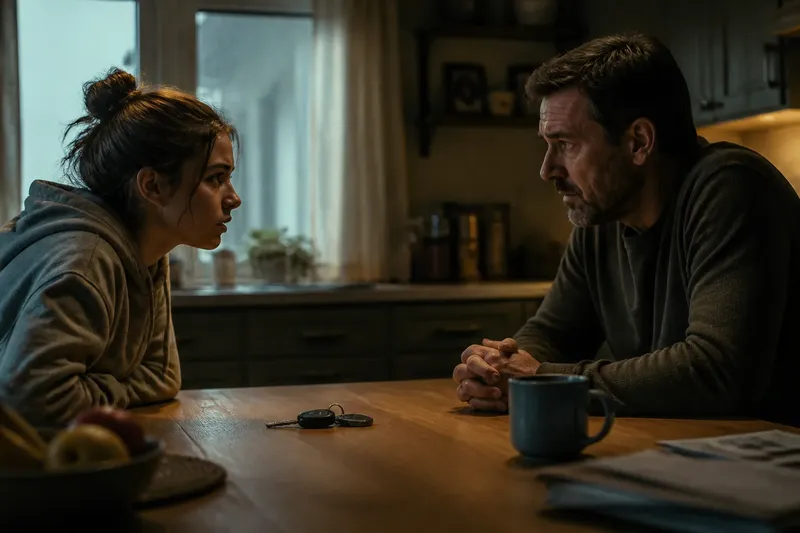
A story beat changes what someone wants, knows or believes about another person. In a scene about a daughter asking her father to lend her his car, the beat might arrive when she learns he has already promised it to her brother. The room has not changed, but the scene has: her request now means something different.
Tracking these shifts can clarify a scene without turning it into a row of prescribed plot points. Try a week-long routine: begin with one scene, mark the changes you can actually see, then revise only where the action or dialogue fails to carry them. The aim is not to make every exchange dramatic. It is to notice when the scene’s pressure has shifted—and make that shift legible.
What does a story beat change?
A beat is a small unit of dramatic movement, not simply a pause or a line of dialogue. It begins with a character pursuing something, meeting a change in the situation, and adjusting—or refusing to adjust. That movement can be subtle: a question gets a guarded answer, a joke lands badly, or an offer turns out to have a condition.
Three kinds of change are especially useful to track:
- Aim: A character switches tactics or decides to pursue a different outcome. A request becomes a bargain; a bargain becomes a threat.
- Information: Someone learns, reveals or misreads something that alters what they can do next.
- Relationship: Trust, dependence, authority or distance shifts between people, even if neither names it.
These categories can overlap. A character who discovers that a friend has read a private letter gains information and may lose trust. You do not need to label every overlap. The categories are a way to ask what, if anything, has changed.
How should you map one scene this week?
Keep the exercise small: choose a scene you have drafted, or write a brief exchange between two people who want different things. Use a notebook or a plain document; coloured highlighters can help, but they are not essential. Work through the scene over several short sessions rather than polishing every line at once.
Day one: What does each person want?
Write one plain sentence for each character’s immediate aim. Make it playable: “get Mara to stay” gives an actor something to pursue; “feel less lonely” is an inner state that may need translating into behaviour. Add what each character thinks the other person wants, if that assumption matters.
For the car scene, the daughter wants permission to borrow the car. Her father wants to avoid choosing between his children. Those aims can pull against each other even while they speak politely.
Day two: Where does the situation turn?
Read the scene once without editing. Mark a possible beat wherever someone receives new information, changes tactics, or treats the other person differently. A beat may begin with a line, an action, or a silence, but the mark matters only if something shifts after it.
If you cannot describe the change in a short phrase—“she softens”, “he withholds the real reason”—the moment may be atmospheric rather than a beat. Atmosphere still has a place; this exercise simply separates it from dramatic movement.
Day three: What can the audience see?
For each marked shift, identify the evidence available to a viewer. It might be a character correcting a detail, withdrawing an offer, changing the subject, or waiting for an answer that never comes. If the change exists only in your explanation of the scene, look for an action or line that lets it register without spelling it out.
Imagine the daughter learns that her brother has the car for a job interview. She stops asking for the keys and asks whether her father told him first. The observable shift is from seeking permission to challenging the fairness of the decision; the new information changes both her tactic and the relationship’s temperature.
Day four: Does the next beat follow?
Check whether each change affects what happens next. If the daughter’s question about fairness receives the same answer as her original request, the scene may be circling. The father could instead disclose that he offered the car before hearing her plans, or she could reveal that she needs it for a reason she has been hiding. Either turn gives the next exchange something new to respond to.
This is not a demand for a twist. A character may repeat an aim deliberately, especially when the refusal itself is the point. The useful question is whether the repetition increases pressure, exposes a tactic or changes the cost of continuing.
Day five: What can you cut or clarify?
Read the scene aloud, then remove lines that merely restate a change the audience already understands. Keep a line if it adds a new piece of information, sharpens an aim, complicates the relationship or gives a character a revealing way to avoid the issue. Leave room for gestures and pauses to do work; dialogue does not have to announce every beat.
What questions help you find the beat?
Can a beat happen without dialogue?
Yes. A character can slide a document across a table, take back an offered hand, or leave before hearing the answer. The action becomes a beat when it alters an aim, information or relationship and changes what follows.
Does every line need to mark a new beat?
No. Several lines may belong to one beat while a character tries the same tactic or waits for a response. Mark changes in dramatic direction, not every sentence or pause.
What if the scene has no obvious shift?
Ask what each person is trying to preserve, conceal or avoid, then look for a moment when that effort becomes harder. If nothing changes, the scene may be setting a mood or delivering necessary information; consider whether it needs a sharper turn or a shorter form.
How can a quiet beat feel clear?
Give the audience a visible contrast between what came before and what comes after. A character who previously filled every silence might leave a question unanswered, making the withdrawal itself readable without a speech about hurt.
When should you leave the scene alone?
Do not force a new shift into every exchange. Some scenes hold a character in a steady state so that the audience can attend to texture, uncertainty or a developing mood. The map is a diagnostic tool, not a scorecard: if the scene has a clear purpose and its stillness is deliberate, the absence of frequent turns may be exactly right.
Likewise, not every beat needs an explanation. If a character’s offer changes the other person’s behaviour, the audience may understand the shift through the response. Add explicit dialogue only when the meaning is genuinely hard to follow, not because the outline contains a blank.
How does this routine help a finished draft?
At the end of the week, put the scene aside briefly, then read it once for the audience’s experience. Can you follow what each person wants, notice the information that alters the exchange, and sense when the relationship moves? If the answers are yes, the beats are doing their job, whether or not you keep the marks in your draft.
Keep the main search phrase, story beat, in mind as a description of change rather than a screenplay rule. A beat earns its place when it gives the next moment a different meaning, choice or cost. When it does not, the simplest improvement may be to cut it—or let the scene breathe without pretending that something has turned.