Before Dialogue Took the Lead: Intertitles and Silent-Era Storytelling
Intertitles in silent-era films shared the storytelling with gesture and image order; learn how the cards clarified speech, time and plot without taking over.
Intertitles in silent-era films did not carry the story alone: a raised hand, a cut to a doorway and a brief written card could each supply a different piece of meaning. The cards made words visible, but their force depended on where they appeared and what the images had already shown.
What were intertitles in silent films?
Intertitles were filmed cards inserted between shots, usually bearing printed or handwritten text. A card might give a character’s spoken words, identify a place or time, or supply information the images could not easily communicate. Their appearance interrupted the moving image, then returned the viewer to it.
“Title” was a broad period term for such cards; “intertitle” describes one placed between scenes or shots. A dialogue title commonly presented a line spoken by a character. An expository title offered context, such as a change of location or a piece of background information. The distinction matters because dialogue cards often acted like a turn in conversation, while explanatory cards could reshape how the next image was understood.
These were not subtitles laid over a continuously visible scene. The card occupied its own shot. That made its timing and placement part of the film’s editing: a line could appear before a reaction, after a gesture, or between two views of the same character. Each choice asked the audience to connect text and image.
How did gestures carry meaning without spoken dialogue?
Gesture gave a character’s intention a visible form. A glance towards an exit might suggest escape; a hand held out could signal a request, an offer or a warning. The surrounding action and the viewer’s knowledge determined which reading made sense. A gesture was not a universal word with one fixed translation.
Silent-era performers often made physical actions legible at a glance. A turn of the body could expose a character’s refusal, while a pause before accepting an object could make reluctance clear. The camera’s framing mattered: a small movement could be readable in a close view but disappear in a distant, crowded composition.
Gesture also created room for ambiguity. A character might smile while concealing an object, leaving the audience to notice a mismatch between expression and action. A title could settle that uncertainty, deepen it or leave it unresolved. The choice shaped not only what the audience knew, but when it knew it.
How did image order and intertitles divide the storytelling?
Image order established relationships that a card could then sharpen. Show a character looking off-screen, then cut to a closed gate, and the viewer can infer a barrier without words. Add a card saying “The road is closed,” and the image becomes specific; omit it, and the gate may carry a more open meaning.
A useful way to think about the division is that images show evidence, gestures show response, and cards can name, locate or complicate what the viewer sees. The roles overlap. A character’s face can contradict a line on a card, and the contradiction may be more revealing than either element by itself.
Order can also change the meaning of the same material. A card placed before a shot prepares the viewer to look for a particular detail. Placed afterwards, it can recast the detail as a clue. A reaction shown before the action that caused it can create suspense; shown afterwards, it may simply confirm the event.
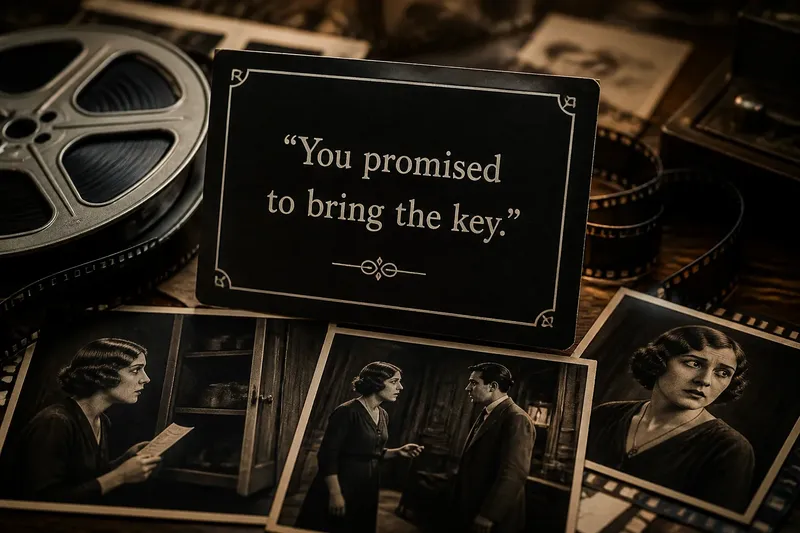
Imagine a character opening an empty cupboard, glancing towards a companion and then looking down at a note. If the card reads “You promised to bring the key,” the glance may feel accusatory. If the note is shown first, the same glance may read as a plea for help. The shots have not changed; their order and the card have steered the relationship.
When did a film need a dialogue card?
A dialogue card was useful when the exact wording mattered more than an actor’s visible reaction could convey. A promise, accusation or pointed joke might hinge on a particular phrase. A card could preserve that wording, but it also stopped the action long enough for the audience to read it.
It was less necessary when gesture, expression and context already made the exchange clear. A character handing over a letter while another turns away may communicate rejection without spelling it out. Adding a card that explains the feeling can flatten the scene by naming what the performance has already shown.
Cards were also a practical way to handle information that would be awkward to stage. A change in location, an elapsed stretch of time or a piece of backstory could be stated briefly rather than acted out. The trade-off was pace: a card could make a jump easy to follow, but too many explanations could make the film feel stop-start.
What can intertitles teach a filmmaker today?
They offer a clear exercise in dividing information among performance, image and text. In a short scene, ask what the audience can infer from the blocking and objects before adding words. Then decide which detail genuinely needs to be stated, and place that statement where it will change the meaning of the surrounding shots.
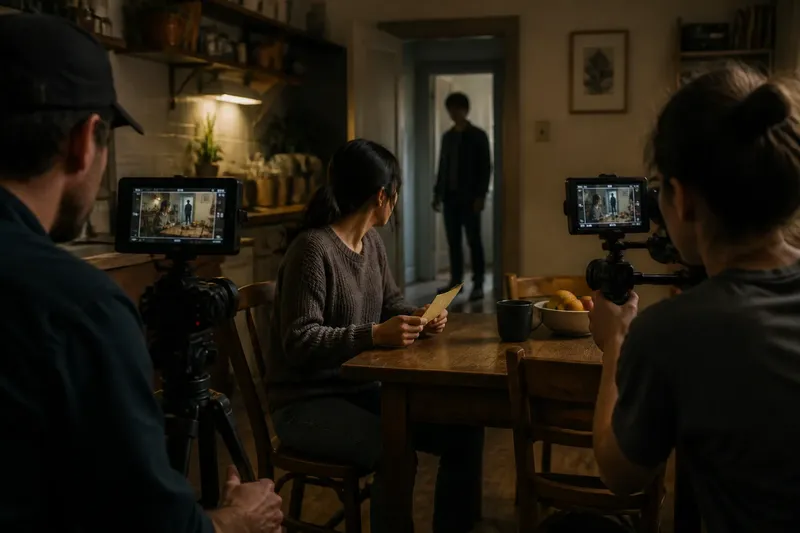
For instance, imagine a filmmaker staging a silent argument in a kitchen. One actor puts a cup on the table; the other slides it away without looking up. A card reading “You said you would stay” could give the gesture a specific emotional context, while leaving the card out might let the audience interpret the refusal from the performance alone.
Try drafting the scene twice: once with cards and once without them. Compare where the viewer’s attention goes, which motives remain uncertain and whether the action still reads clearly. This is not a contest to eliminate text. It is a way to notice what each form contributes.
Which questions about intertitles come up most?
Were all intertitles dialogue?
No. Some presented spoken lines, while others identified a setting, marked a time change or supplied context. Their function depended on the information the film needed to deliver.
Did silent films have no sound at all?
“Silent” refers chiefly to the absence of synchronized recorded dialogue in the film itself. Screenings could include live musical accompaniment or other performance, so the viewing room was not necessarily quiet.
Why not put the words over the picture?
A separate card gave written information a distinct visual beat and kept it from covering the action. It also allowed a filmmaker to control how the audience moved from reading back to watching.
Could a film tell a story without intertitles?
Yes, if its images, performances and editing made the essential action understandable. A film could also use a small number of cards for details that were difficult to convey visually, rather than choosing between text and image as an all-or-nothing rule.
How can you judge whether a card belongs?
Ask what new work the card performs. Does it provide a necessary name or time shift, make a crucial line legible, or deliberately alter the reading of the next image? If it merely repeats a clear expression or action, the scene may be stronger without it.
Read the card in relation to the shots on both sides, not as a sentence on its own. A concise line can feel heavy if the action has already explained it; a longer one may earn its place if it changes the stakes. Consider whether the audience needs the information now, later or not at all.
Intertitles are most revealing when treated as part of the film’s visual rhythm rather than as a substitute for speech. Their placement can turn a look into an answer, a pause into suspense, or a familiar gesture into a question. For anyone studying intertitles in silent-era storytelling, the useful habit is to watch the exchange between card and image: what each gives, what it withholds and what becomes visible in the space between them.